Gardeners Diary


For some reason it is only after Christmas that the Wisteria seems to call me for its winter prune.  Before that, it just seems to be doing fine and then after the holiday, it suddenly seems in dire need of a serious prune.  As many of you will know, I usually do (or at least start) the job on New Year’s Day, but this year the weather was so wet and gloomy that I only started on the job today.

If you have a wisteria to prune and are not confident as to how to do it, take a look at the video I did of the process last year.  Some friends of mine watched the video last year and after pruning their wisteria, had blooms on it for the first time last spring.  I can’t promise that this will happen for you as the plant has to be mature enough to flower, but if lack of pruning was the cause for few or no flowers, then the video should help.  Even if the plant isn’t ready to flower yet, pruning is important in establishing a framework for the future.

Wisteria Knot

If you don’t get the structure right from the beginning then you can get congestion points or “knots”.  Here a side shoot has grown and forced itself behind a main stem.  This has created a very congested area where it is virtually impossible to get in to remove material.  In previous years, I have pruned as much as I could, but the problem just gets worse as each year even more shoots make the problem worse.

This year, I will prune all around the area to give myself as much visibility as possible.  I will not worry about the three bud principle as I am not trying to get flowers here, but rather to resolve the congestion.  I will then take my pruning saw to the major offenders and hopefully that will sort the issue out.

Hopefully this will be in the next week or two and I will post after the job is done to let you see the results.

Well finally, the two topics of this blog come together – the puppies have experienced the outside world, ie the garden.   The playpen is now a feature of the garden for the next few months.  Thank goodness we designed the patio area with this in mind and the pen is very close to the house making it easy to transport the pups between the two locations.

Obviously they aren’t outside for long and they spend most of their time in their indoor pen, but they are starting to learn that we would prefer it if they went to the loo outside.  This is fairly natural behaviour as naturally they don’t want to soil their sleeping area – but it is necessary to help this natural instinct.  When they wake up, the first thought is to go to the toilet – it is therefore important that they are put outside as soon as they wake up.   They probably go outside about six to eight times a day.  The good news is that this hard work is paying off and we hardly ever have a poo indoors.  There have also been occasions when the pups have made some noise and when taken outside have promptly made good use of the facilities, so the message certainly seems to be getting through.

As time goes by (and the weather improves) the puppy we keep will spend much more time in the garden, and no doubt give me much more to blog about :).

Recently we had a very exciting experience – the garden was interviewed for Amateur Gardening magazine.  Each week, the magazine features a different Yellow Book garden, and our local organiser had nominated mine.  After a few emails and details of the garden’s website and this blog being provided, an appointment was made for the magazine to come and see the garden.

Being Interviewed

The journalist and photographer arrived at 10 am on a beautifully sunny day and immediately got to work.  Initially I had the dogs out of the way so that we could chat.  It turned out that the journalist had a seven month old English Springer, so we definitely had a lot to talk about.  We started with a tour round the garden (which was pretty hard as she was taping it and I had to describe what we were discussing, rather than just say “this plant”).  Then we just conversed about the garden.  She asked all sorts of questions from the amount of watering I do (very little given our clay soil) to how much we lost last winter (again, very little).  We obviously talked a lot about the impact of the dogs on the garden and how this had affected the design.  I also explained how to protect the garden from the dogs.  Thinking back, I know we never stopped chatting (apart from to sip our tea), but I really can’t believe how quickly the time went.

g

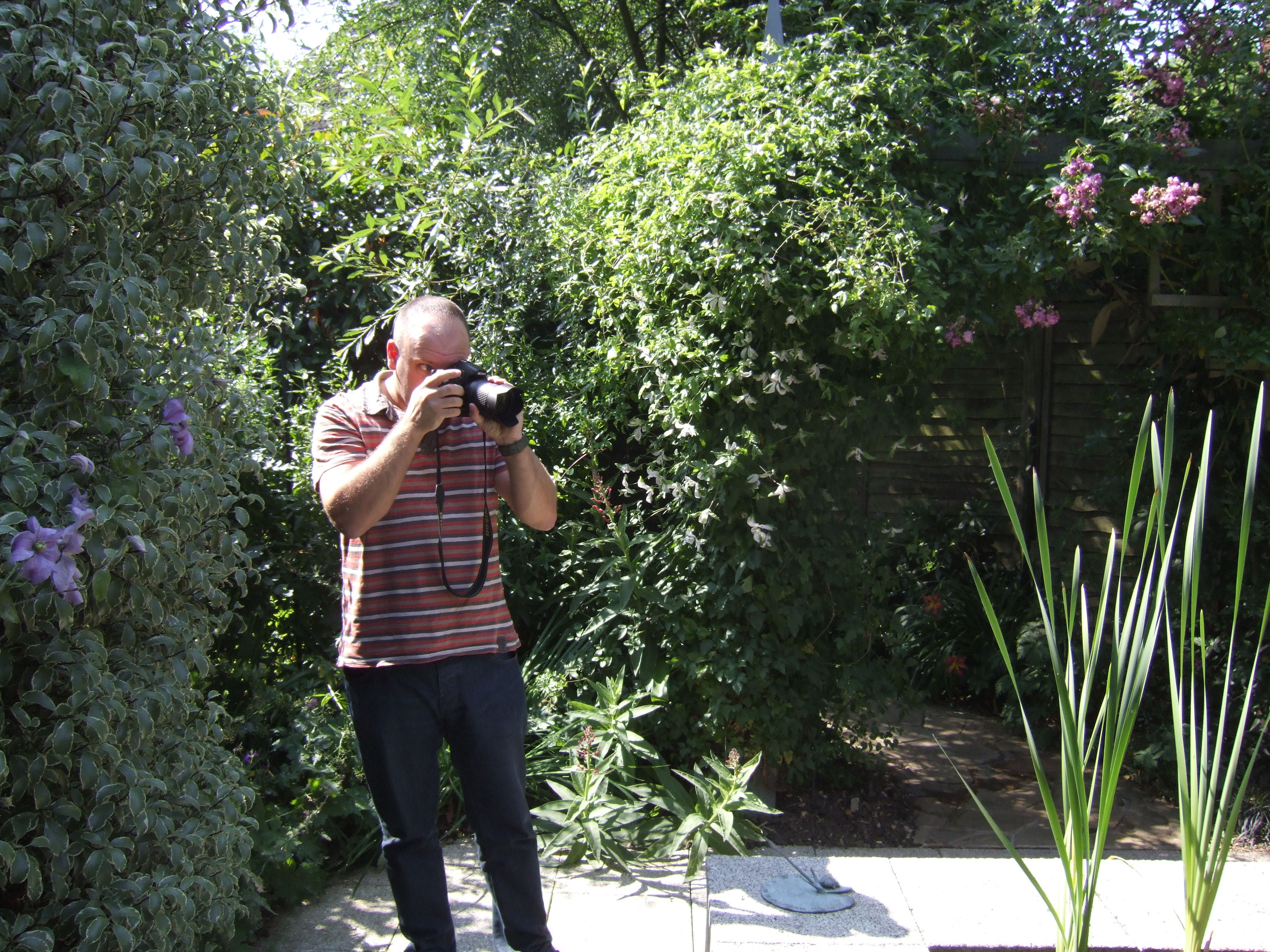
Photographer hard at work

While the journalist and I were talking, the photographer wandered around taking photos.  To get a better perspective on the garden, he borrowed some ladders and Brian even took him upstairs to get some “arial shots”.  By the end of the day, he had taken 350 photos!  Very kindly, he has offered to let me have the ones not used by the magazine, so I will have a wonderful record of the garden.

Before I knew it, two hours had gone by and the photographer wanted to check that he had photos of all the areas that the journalist wanted to feature, so we left them to it for a few minutes.  Then the next thing to do was to discuss the area of the garden to feature.  They always select an area of the garden and then highlight a number of specifics in that area.  We looked at a few possibilities, and settled on an area by the pond.  Then photos were needed of the elements of interest.  The only plant that the dogs eat in my garden is the grass (well, miscanthus), so they decided that this might be an interesting thing to feature.  Of course, the dogs  wouldn’t eat it on command!  So we tried smearing it with a molasses canine food supplement that I always keep in stock.  But that didn’t work either.  We had given up and moved on to other things, when they decided to start eating the miscathus again.

After that, we had to do the shot that featured the owners.  These included the dogs as the garden is just as much about them as it is about us.  Then after almost three hours with us, they left.  I had asked if the garden would definitely be in the magazine and was told that it would be, but the journalist had no idea when.  If it is published in winter, the article will be four pages and if it is summer then it will be six pages (there is more advertising revenue in summer and so the magazine is bigger).  The last bit of homework to do is to get them the measurements of the garden.   I promise I will let you know when the article is published!

« Previous PageNext Page »